Manifold-guided semantic cues
Can compact models preserve semantic structure before and after decoding?
YVIC Research studies compact, on-device language models — especially how their embedding geometry changes under compression and deployment limits.
Current work uses semantic anchors to stabilize compact models, and probes whether prompt-injection structure is already visible before any output token is produced.
Enter the research index ↓ECR / Semantic anchors become lightweight prefix control tokens that help compact models keep task-relevant geometry stable.
Position
Language models change when they leave the lab.
YVIC Research is an independent effort in Taipei, focused on how language models behave once they run under real deployment limits — on phones and edge devices, with no cloud model behind them.
One line of work studies compact multilingual training through embedding geometry. Embedding Consistency Regulation derives semantic anchors from teacher embeddings computed once offline, then uses prefix control tokens to keep a compact model's representation space from drifting during training. It does not match teacher logits, hidden states, or internal features, and it does not change the decoding architecture.
A second thread asks whether jailbreak and prompt-injection prompts leave a geometric trace before decoding. It scores the final-layer, final-token representation with a frozen cosine margin between injected and benign K-means anchors. The point is observational: no classifier is trained, no model weights are changed, and the threshold is fixed before transfer benchmarks.
Research index
Current lines of inquiry

Researcher Engineer
Chung-Wei
(Victor) Yuan
袁崇惟
Selected work
Manuscripts & research systems
System study / fully offline
Luna lives
on the device.
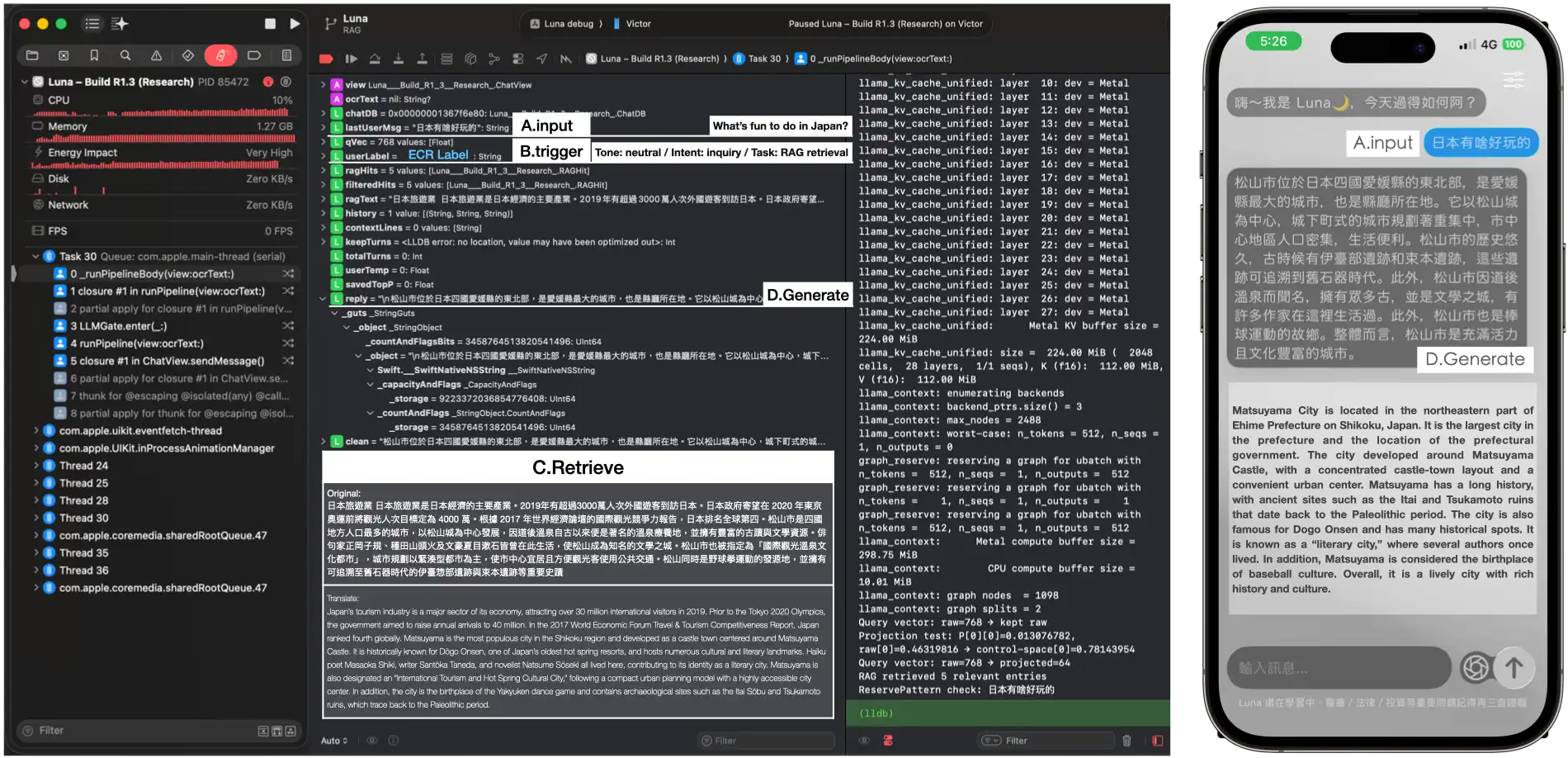
Luna runs a compact language model and a local retrieval index entirely on the device — no network, no cloud model. It is the testbed for studying how ECR and conditioning hold up once a model is quantized and deployed for real.
Maintained as a research system for local, private language-model deployment.